
Trinity Fire & Security Systems is a PTSG company specialising in the design, installation and maintenance of fire and security systems. Max Harris joined Trinity in May 2017 as a 21-year-old apprentice. Nine years on, he is Works Manager for the South Coast which includes overseeing the hospital where he used to be a Porter. His story is one of belief, hard graft and knowing when to take a risk.
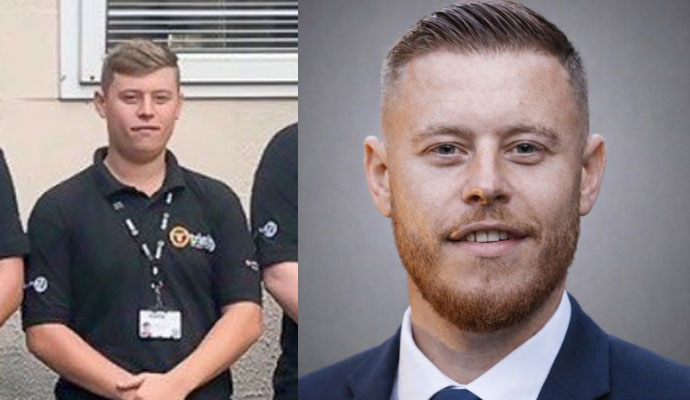
Max Harris was not your typical apprentice. When he joined Trinity in 2017, he was 21 years old, had a 12-month-old baby, and was walking away from a steady income as a porter at his local hospital to take on an apprenticeship paying £9,000 a year.
“I had rent to pay and a baby on the way. But sometimes you have to take a step back to move forward.”
The opportunity came about through a conversation at the hospital. The operations manager Max worked under suggested he look into it, and put his name forward to Connor Hobby, a Trinity engineer at the time. Connor passed the recommendation to his manager, Dean Cross.
“Connor didn’t know me. He didn’t know anything about me,” Max recalls. “He just went to Dean and said, I’ve got a guy who’d be a great apprentice. Dean put every faith into me without even knowing me. That’s always stayed with me – he believed in me when probably no one else did, to be honest.”
Max completed a Level 3 Fire and Security Emergency Systems Technician apprenticeship at Yeovil College, attending on block weeks over three years. He had to resit his maths and English, having not done well in those subjects at school – something he describes, with characteristic honesty, as a clean slate.
Trinity’s support during that period was practical as well as personal. When Max needed to cover portfolio units that weren’t available in his own region, Dean arranged for him to travel to Exeter to complete CCTV work. Fellow engineers gave their time freely. Mark Evans, still with Trinity today, helped him throughout. And Chris Fletcher – then an engineer, later a works manager himself – became a particular influence.
“Chris is my work father,” Max says. “He got me into the installation side, moulded me and guided me through. We’ve still got a really close relationship. He’s moved into another division within Trinity, and I’ve basically taken over his job.”
Having qualified in 2020, Max moved into a service engineer role – though in practice he had been doing service work throughout his apprenticeship, volunteering for the out-of-hours call-out rota to add extra capacity to the team. His main site was Salisbury Hospital, a large multi-panel Gent networked fire alarm system that he knew intimately – not just technically, but physically, having worked there as a porter.
“I know the back end of that hospital inside out,” he says. “It’s a massive bonus because the site knowledge is everything. I still have a really good relationship with Pete Dobey, the fire officer down there.”
In 2022, Chris Fletcher brought Max across to the works team – the side of the business focused on installation and commissioning rather than servicing. It meant coming off the call-out rota and learning a new discipline: going into sites to install new systems, commission equipment and carry out remedial works recommended through the service team’s site surveys. Max completed advanced Gent training to support the work, much of it tied back to Salisbury and other sites he already knew well.
Earlier this year, Max was promoted to Works Manager for the South Coast – a role that had previously been held by Chris Fletcher. He manages a team of four engineers across the region, scheduling their work, managing deadlines, overseeing documentation and ensuring jobs are properly resourced.
He nearly did not go for it. “I was nervous. I didn’t think I’d get the opportunity,” he admits. It was Steve Ausden, a senior manager at Trinity who has been with the business throughout Max’s career, who backed him. “He took me under his wing and he’s there whenever I need him.”
The move to an office-based role took some adjustment. Max describes being sceptical at first – spending nine years on the tools makes a desk feel unfamiliar. But the structure has suited him, and the effect on family life has been significant. He has two young children and two stepchildren, and the predictability of the new role means he can help with school runs and keep more regular hours.
Max has been with Trinity for nine years – through an apprenticeship, three engineering roles and now a management position. He is straightforward about what has kept him there.
“I don’t feel like a number,” he says. “No one looks down on you. Everyone I’ve worked with has supported me. I haven’t felt the need to look anywhere else.”
He is also clear about what makes Trinity’s client relationships work. “The engineer is the face of the company,” he says. “If you’re getting on with the client and doing your work to a high standard, the customer stays with you. A long-standing relationship like Salisbury Hospital – that’s built by the engineers they see walking through the door.”
Asked what he would tell his younger self, Max does not hesitate. “In the politest possible way – pull your finger out and do it at 16, not 21.” He laughs, then gets more serious. “You’ve got to back yourself. It doesn’t happen overnight. But if you put the work in and you want it, there is opportunity there. You just have to stick at it.”
He pauses when asked to reflect on where he started and where he is now. “I was an apprentice, and now I’m a works manager. When you actually look back and look in the mirror – yeah, that is a massive achievement, to be honest. I probably don’t give myself enough credit for it.”
As for what comes next, Max is clear. For now, he is focused on getting the works manager role right. But the ambition is there. “I just want to keep climbing,” he says. “Keep climbing that ladder.”